
● SEPTEMBER 24, 2026
Thropic Games: Fundraising That Feels Like Fandom
— EDITOR'S NOTE
Volume 34. Brick by brick. I’m proud of what we’re building with No Huddle. It's on its way to becoming the go-to source covering the intersection of sports, business, and entrepreneurship. People want digestible sports-business coverage and early access to the next big thing.
Huge shoutout to our partners at Goodwin for the first-ever IRL No Huddle event. Small group, real conversations. More to come… and reach out if you want to be part of the next one.

As always, if you want to be featured, connect with founders in the No Huddle family, or have suggestions to help No Huddle grow, just reply to this email or reach out directly to me at [email protected]. Let’s keep it rollin’! 🤘
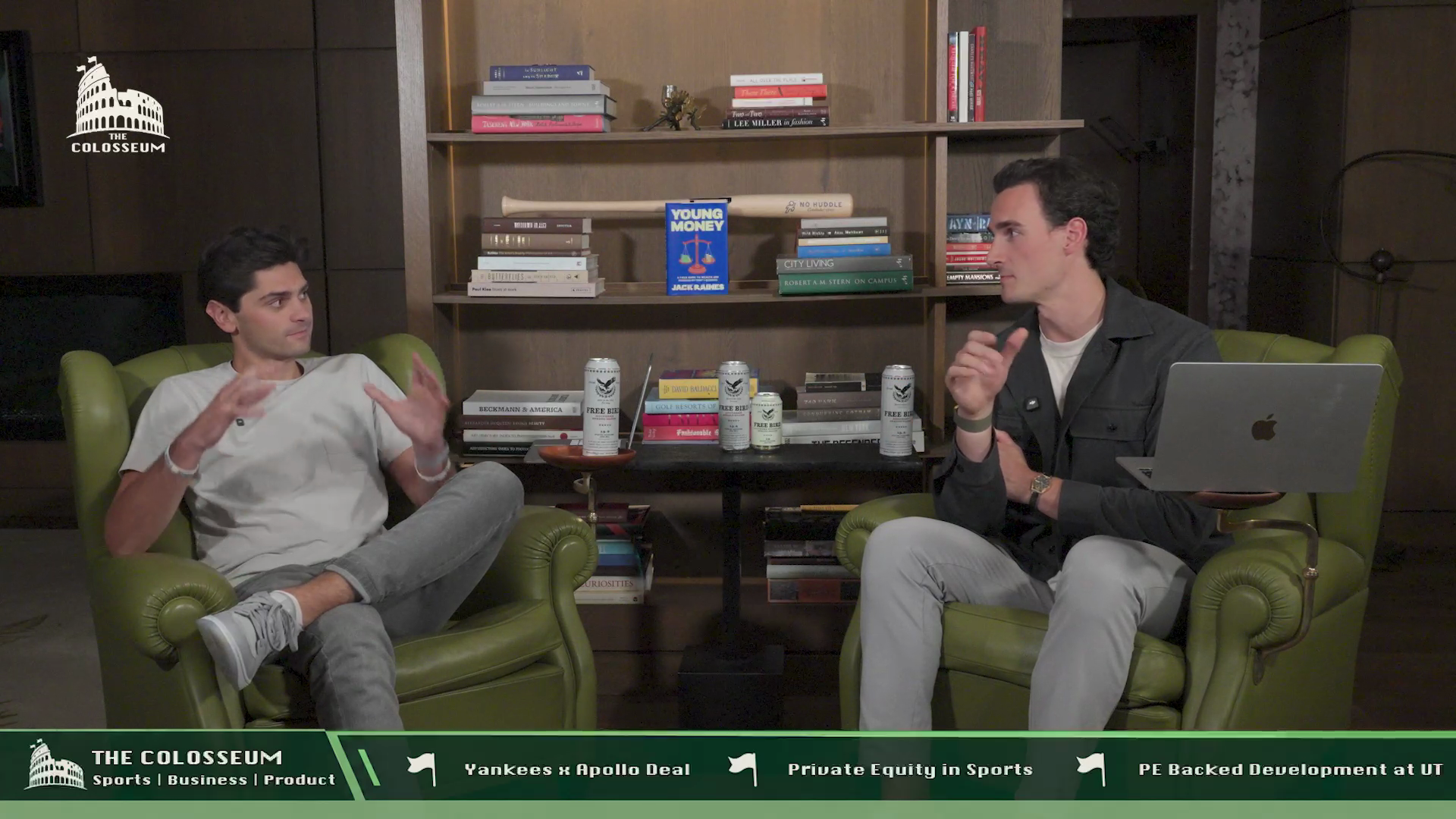
👀 The show I've been teasing is finally here. Check out Episode 1 of The Colosseum below. 👇
|
||||||
|
||||||
|
||||||
|
Sports Is All About the (PE) Money — Yankees × Apollo & Neyland × Arctos | The Colosseum Ep. 1
A new YouTube show from No Huddle on the deals moving the industry and the founders, operators, and companies building what comes next.
|
||||||
|
On the episode
|
||||||
| With Sam Foley, founder of No Huddle, and Joey Lindstrom, national play-by-play broadcaster. | ||||||
|
||||||
| A No Huddle and Wagon Media production. |


🎙 IN THE POCKET
How I am seeing the field across sports, media, entertainment, wellness and CPG
"The stadium was full an hour early. So, I guess I had to leave to get them to do that. So, you're welcome."
That’s Lane Kiffin for you. In his LSU visor, as braggadocious as ever, after his former Rebel squad sent him back to Baton Rouge in front of 70,000+ in Oxford with an L. I have no dog in this fight, but that was nothing but cinema. The revenge tour, the hate, the passion, the signs, the electricity… all for a Week 3 game!
I was at a packed bar in the East Village with a bunch of NESCAC alums, none of which had any association to either team, but we were watching like it was a playoff game. Fandom has no bounds. The money knows it, too… And schools are just starting to really figure that part out.
Also last Saturday, up in Knoxville, the University of Tennessee ceremoniously grabbed a shovel to break ground on 865 Neyland. The project includes 100,000 square feet of entertainment space, 186 hotel rooms, 51 luxury residences, a 24-story tower, two plazas and a 50-foot stage all dropped into the space between Neyland Stadium and Food City Center (basketball) on campus. And a sick hype video to boast. The price? The complex is privately funded, expected to cost nearly $300 million, and will open in phases starting in 2027. And that’s on top of the $337 million poured into Neyland Stadium for renovations and premium suites.
We’re seeing more and more of this: how can we get fans to come 365 days a year? And how can we make gameday weekends an experience that draws in alumni, students and fans from all over - like that group of NESCAC guys at a bar in the East Village.
Amidst all of the commotion in college sports, Ted Cruz joining College Gameday, players trying to come back to college AFTER playing in the NFL (?!), and the debacle of a ref show that was Western Michigan vs. Michigan in week 1, it feels like the product on and around the football field has never been better.
Cruz went on GameDay to pitch the Senate's college sports bill and got serenaded with “‘Ted, you suck" by the Texas crowd. That game, Texas-Ohio State, did 13.99 million viewers on ABC - the biggest Week 2 audience on record.
Lots to dig into there, and I'll get to all of it as we slowly expand our reach as an emerging, creator-led sports media company covering what people actually want out of this industry.
But one thing is clear: the fans aren't the problem here. I keep coming back to different variants of the same theme - Volume 29 covered Ballers, which sells membership as part of your identity, the kind of thing people want to tell you about so they can drop the "you should join." Volume 7 (On Location) and Volume 1 (Cosm) pulled on very similar threads.
It’s the same finding every time: people will pony up for a day they'll still be telling stories about. And if they feel a part of it - whether that’s as an alum, parent, local, or just fan - they are willing to pay a premium to get the full experience. College is a cheat code to this membership and identity yearning - some people are literally born into it!
Also on that spectrum is people's desire to compete. Volume 13 (Lucra) and Volume 16 (Schoolyard Social) were both bets that the competition layer is a business on its own, and both have held up just fine.
I've been preaching from the rooftops that college fan loyalty is the most concentrated, least commercialized asset in American sports, but sometimes asking the same people for more has a ceiling - especially when NIL has no bounds. And the pressure is real: 94% of Division I programs spent more than they generated last year, with the median school running a $20 million deficit, up from $12.3 million a decade ago. Tennessee can pretty easily raise $300 million privately. Sam Houston State cannot. The creative solution is to give everybody else a reason to show up and donate as well.
Meet Thropic Games, built by a former sportsbook CMO who took the fandom machine and pointed it to a wider, but just as rabid market.
More below. 👇
📺 THE WATCH LIST
Thropic Games
A mini investment memo on the stars of tomorrow

The Company: Thropic Games
The Business in a tweet: Thropic is gamified fundraising software for schools, teams, nonprofits and brands. Fans play casual and “mini” games built around the themes they already follow, a dollar donated equals an additional entry toward real prizes, and the proceeds route back to the athletic department or the cause behind the game. Family Feud meets GoFundMe, with a first-party fan data layer running underneath it.

The 101:
Industry: Sports Technology / Fan Gaming / Revenue & Fundraising
Headquarters: Denver, CO
Year Founded: 2025
Founding Team/Current Leadership:
Kyle Christensen - Co-Founder & CEO: Former collegiate athlete who started at Fox Sports, then ran product and growth marketing at Netflix and worked on ads and commerce platforms at Meta, where he learned how social graphs and consumer data attribution actually work at scale. Kyle was also the CMO of PointsBet and ran a nine-figure marketing budget through the Fanatics sale, then built the Splash Sports brand from scratch before founding Thropic. He has 15+ years scaling consumer platforms.
Bret Forester - Co-Founder & Chief Product Officer: Three-time founder, including Beer Drop (acquired) and Craft Alley. Full-stack product and engineering leader with DTC and marketplace experience.
Advisors and members of the cap table include: Tyrel Kirkham (CMO, Charlotte Hornets), Jeff Cova (President, Winspire), Matt Trandall (Head of Sales, Lyft), Josh Golden (CMO, Quad), Dave Arnold (CCO, Audigent), Marc Simone (CEO, Coyote) and Sue Schneider (Co-Founder, DTO).
Employees: 2 full-time, tech-enabled foundation allows for further efficiencies with an AI enabled platform to build across enterprises.
Fundraising Status:
Pre-seed closed July 2026 led by The Famous Group, whose Vixi in-venue interactivity suite runs in 500+ venues across 15 countries.
Strategic investor: the plan is to wire Vixi and Thropic together so the fan in section 112 and the fan on a couch in Dallas are playing the same game.
Also included Strategic angels out of gaming, fundraising and sports round out the round.
$2.4M seed open now
Will grant Thropic 18 to 24 months of runway - plan is to allocate $1.2M to engineering and product, $500K to sales and partnerships, $400K to marketing and prizing, and $300K to compliance, deal structure, insurance and payment infrastructure.
Series A milestones: 50+ active schools, $5.25M+ ARR, 30K+ monthly users, 3+ conference deals, one new market in high school or youth sports.
If you’re interested in learning more or meeting the team, respond to this email or reach out to [email protected].
Business Model:
SaaS subscriptions for enterprise clients
Roughly a 20% take of funds raised through the platform
A revenue share on sponsors attached to client games
A full-service tier where Thropic funds the media and the prizing itself, takes a higher share on the back end

Traction:
13 deals closed and counting: Ole Miss, Texas A&M, Arkansas, Colorado, Syracuse, Cal, and more to come soon!
30+ schools in the pipeline
105 nonprofits served, including St. Jude, the American Heart Association and Boys & Girls Club
20,000+ users on platform
YoY revenue growth: 500%
70% of fans who land on a game sign up. Average gift $74. Roughly $15 of platform revenue per player.
Enterprise and brand partners include: NBCUniversal, AEG, (the College Basketball Crown), Lalo, Outlaw Beer, Pearson, and the Principal Charity Classic
Distribution partnership with TheLinkU
Compliance: independent legal letters concluding the model is not gambling under federal law and is cleared for charitable fundraising in every required state, the first NIL Go attestation in the category, NCAA Bylaw 10.3 alignment, and a built-in compliance partnership with CSC
What’s Next? Champion Model, which turns the fundraiser into a competition between people rather than a competition inside a game. A school runs a contest for #1 Fan or Cutest Ole Miss Baby, fans submit why they deserve the title, every champion is assigned to recruit their own network, and every dollar donated is a vote.

The Ole Miss pilot, broken down:
Thropic ran a four-week preseason campaign for Ole Miss called Road to Kickoff and priced the media the same way any sponsor's buy would be measured. For every $1K spent, the pilot produced 109,026 impressions, 53,231 accounts reached, 3,998 unique players and a cost per acquired player under $4.
The creative finding is what I find most interesting:
Three player-driven videos featuring Ole Miss QB Trinidad Chambliss drove 29,186 combined post engagements at a 4.6% average video CTR and $0.22 CPC. The static branded graphic ran 2.41% and $0.34. The athlete on camera out-clicked the logo by 62 to 107% and cost 24 to 38% less per click.
Oh… and the whole Lane Kiffin drama probably helped too!

Source: Thropic Games
Deep Dive:
Pros:
Kyle saw this machine from the other side as part of the boom in sports engagement, gaming and betting. He knows what consumers want, and has built engines that have worked.
Media efficiency is measured, not just modeled in a spreadsheet: Unlike a lot of companies pitching schools, Thropic has clear KPIs to measure and hit with each of their initiatives. In this case, the ad is the game, not just an ask to click. Most channels are measured on open rates (No Huddle included!), but Thropic is measured in the same dashboard that schools - or their MMR partners - already use to track revenue.
Net new revenue back to athletic departments: Thropic isn’t trying to reallocate spend or talent, instead it’s pitching an add-on service that can significantly boost engagement and also improve the schools top line. That’s a clear pitch that has landed.
Compliance from a point of strength: Kyle and team built this with the same guardrails he dealt with at big tech and in the gambling industry. It’s paramount to have the right infrastructure and security around any type of exchange, and the Thropic team has treated it that way from the jump - which general counsels will like to hear!
Athletes buy-in - also helps with their own name recognition and complete NIL deals: Players will push the games to their own network because they earn NIL revenue from partnering. Data shows that athlete-led creatives may still be the leader in the price to effectiveness ratio for ad buyers. The Ole Miss case study proved this out when Trinidad Chambliss was involved. It’s also a clean chain to stack on top of: the distribution channel, the beneficiary and the best-performing ad are the same person.
The data layer: This is arguably the moat for Thropic. Every school has fan information across fragmented interactions. Thropic is the reason fans keep interacting the same way - showing up for games, competing (hopefully winning) and then coming back for more. Schools can then build a unified fan profile and assign a fan LTV number, while also getting to see what activations led to the most fan engagement.
Fits inside what athletic departments are already doing.
Business can work outside of the college ecosystem as well - also works for non-profit organizations and other entities that have fundraising as a key part of their core operations
Cons:
Lasting power / LTV of a customer: Striking the right balance between fun, winning and revenue. This can be tough to do, but Kyle is a veteran having come from the gaming world. Thropic will need to squarely focused on not only getting users to play games, but keep coming back for more
Fan Fatigue: While I don’t see it, it is possible that consumers swing back and become fatigued by all of the social gaming options. We have companies trying to gamify the everyday consumer's life from morning to night. Will people tire of that - even if it is their school or sports-related? This will be on the Thropic team to continue to innovate and get creative with more games and more ways to engage with fans
Regulation: As we know, college sports is in the hot seat right now - with ideas, legislation, rules and college gameday appearances all intertwined into politics. There’s been some semblance of what a future state of college sports looks like, but not a clear one. Thropic will need to be nimble.
Distracted Buyer: College athletic departments in many ways are being re-built from the ground up. ADs, business officers and coaches all have a growing number of stakeholders to appease, P&L targets to hit and no shortage of companies with creative ideas pitching to them.

Comparables / Thropic Differentiator: Thropic is the only platform that builds a white-labeled gamified revenue loop into the client’s own software at every step of the consumer journey. GiveButter and Blackbaud hold the back office side of things while GiveCampus is a classic donation tool that many of us have seen. Thropic is here to work directly with schools and organizations and give them a co-pilot seat to all of the action, data and of course, revenue back to the school.
📶 THE SIGNAL · NO HUDDLE'S TAKE
Back in Volume 21, I wrote that college athletic departments are sitting on one of the most concentrated loyalty assets in America: thousands of emotionally invested alumni and fans, with little commercial infrastructure beyond a “donate here” button. Waypoint’s answer was to meet fans inside a purchase they were already making. Thropic is solving for the other side of that equation by giving fans a reason to show up, compete, and participate in a cause they already care about.
The charitable component I think is big here too. Thropic is not building the millionth version of a new peer-to-peer betting platform, but it’s using the familiar mechanics of picks, brackets, prizes, and leaderboards to make philanthropy feel more native to fandom. While college sports alone may be a large enough TAM to build a successful business, Thropic’s ability to white-label its platform for nonprofits and other partners expands the opportunity. Those organizations can run branded games around sports and culture, raise money for selected causes, and access payout and reporting infrastructure on the back end.
I love the way that the Thropic team has positioned themselves. Manchester United is worth ~$7.2 billion, with a claimed global fan base of 1.1 billion (about $6.55 per fan). The Lakers’ recent $12.5 billion sale values the franchise at $12.50 per roughly one billion global fans. But Spotify may offer a more useful comparison: the company reaches nearly 800mm monthly active users and understands who those users are, what they engage with, how often they return, and which of them have demonstrated a willingness to pay. The advantage is not just audience size. It is knowing the audience well enough to build a relationship beyond a single transaction.
Now put that in college terms. There is a massive gap between the booster who can write a seven-figure check and the recent graduate navigating rent, student loans, and the rest of adult life. Both may care deeply about the same school. Thropic gives them an accessible way to participate in the same ecosystem: compete in a game, support a team-adjacent cause, and potentially build toward a deeper relationship over time.
That is where the charitable-giving angle becomes especially interesting for college sports. A game can be tied to an athletic department, a specific program, a student-athlete initiative, a scholarship fund, a local community partner, or broader university priorities. For advancement teams, it creates a more engaging on-ramp than a generic annual-fund appeal—and potentially a way to identify who is most engaged before asking them for a larger commitment.
As we all know, college sports are at an old-fashioned stand-off between the haves and have-nots. Ole Miss just posted a record $107.9 million athletics fundraising year, nearly 38% of the entire university's haul. Schools that can do that are fine. The more interesting question is what happens at Fresno State, Butler, and the many programs with real alumni affinity but a fraction of the resources…and nobody calling with a nine-figure media-rights deal. And that’s where Thropic’s broader TAM comes into view. The customer is not necessarily just a college athletic department. It could be the university foundation, alumni office, a local nonprofit, corporate sponsor, or fan community itself. The same product can be deployed as a fan-engagement tool, a fundraising product, a sponsor activation, or a community-impact campaign. That flexibility is a meaningful asset as the college sports ecosystem continues to splinter across new revenue lines.
Kyle’s background in big tech and sportsbooks is a major lever here, too. Free-to-play prediction games have been a proven top-of-funnel engine in sports for years, but the bottom of that funnel has typically been a sportsbook - or - for prediction-market defenders, another form of financial participation. Thropic is betting that the same mechanics can lead somewhere different: toward affiliation, first-party data, and charitable support.
Thropic's underlying bet is that giving has a conversion problem rather than a demand problem. I tend to agree. Fans love their schools, but they feel turned off by a blanket “donate” button at the bottom of a robo-email. Thropic says 70% of the people who land on one of these games sign up… so maybe the thing standing between a fan and a gift was never the money.
If you’re interested in learning more, or meeting the team, respond to this email or reach out to [email protected].
No Huddle is for informational purposes only and is not financial or business advice. The content in this newsletter does not represent the opinions of any other person, business, entity, or sponsor.
FROM THE ARCHIVE
Waypoint and the New College Revenue Playbook
Volume 21 on Waypoint covered the college loyalty asset sitting behind a donate button. Thropic gives fans a reason to show up, compete, and participate on the other side of that equation.
Enjoyed this Issue?
Subscribe to No Huddle for future breakdowns at the intersection of sports, business, capital, founders, and operators.
Know a company we should be paying attention to?
If there's a founder, startup, or sports business worth watching — send it our way.
Sports × Business × Capital.
𝕏
in
@
Founder signals, alumni momentum, and the people shaping what is next. |
READ
Latest Volume
Archive
Alumni
|
ABOUT
Our Standards
Partnerships
Subscribe
|
||
|
||||