

● VOLUME 38 · NOVEMBER 19, 2026
No Huddle: How Trove Is Turning Digital Ripping Into a Collector's Game
— EDITOR'S NOTE
Volume 38. Thank you all for the support. It’s been awesome to watch the No Huddle community come to life, and great to meet so many of you in person lately. And Happy Thanksgiving to all. Lots to be grateful for.
Today’s volume is part one in a series on Trove and the digital ripping craze taking over collectibles culture.
AS SEEN ON X
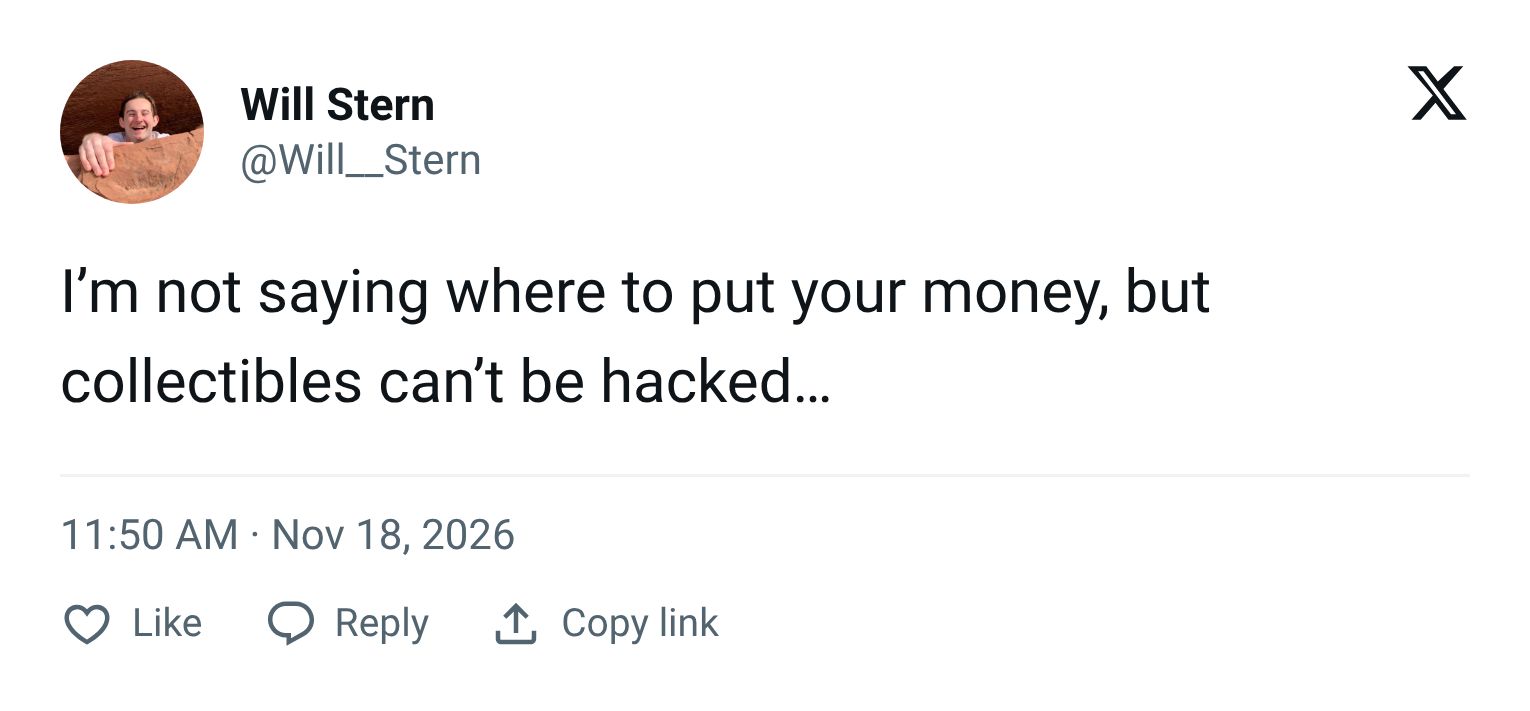
’Nuff said.
|
||
|
||
|
The Colosseum, on YouTube
The Colosseum covers sports and business the way it should be covered. Episodes are built to be easy to digest, mixing founder interviews with real field tests of the products shaping the space. Catch up on all of it on our YouTube channel.
|
||
| With Sam Foley, founder of No Huddle, and Joey Lindstrom, national play-by-play broadcaster. | ||
|
||
| A No Huddle production. |
🎙 IN THE POCKET

How I am seeing the field across sports, media, entertainment, wellness and CPG
Growing up, my younger brothers and I didn’t need a rulebook to play and trade cards. We made games up on the spot - a pitcher and a hitter lined up and rolled the dice. The dice decided whether you got a hit or were out. And if we were playing for keeps, the winner got the card. I’ll never forget my cherished Alex Rodriguez Mariners card (before he went to the Yanks and became the enemy!), or my ’04 David Ortiz Red Sox card. We’d go to stores with the money we had saved up to buy packs, hoping to pull another superstar we could talk about at school and, of course, battle with later.
Little did I know, this fascination of mine would 1) not only stay with me but 2) explode 15 years later into a ginormous - and investable - asset class. When I strolled into CardVault by Tom Brady here in NYC last fall, I felt that same nostalgia. This time, I was curious about the business, too. I picked up some PSA-graded rookie cards for Drake Maye, Roman Anthony and Caleb Williams that felt cheap for what I thought those guys could become (Roman - I still believe in you!), and display them in the home office with the same pride I did collecting with my brothers back in 2010. What made the experience even better was Collector Cash (powered by Cheers Cash), where if I won my free sports prediction on an upcoming game, I’d get store credit to be used towards my next purchase. The Knicks ended up hitting the over, and the next week I was back at CardVault with a discount in my pocket scouring for more.
CardVault reminded me why I loved collecting in the first place. What I didn’t expect was to also find a version of the game my brothers and I made up, right there on my phone.
So what’s actually going on here? Let’s size up the market:
Card Ladder tracked ~$1.07B in card sales in October across 9.2M transactions, its first billion-dollar month, at an average of about $116 a sale.
Sellers on Whatnot did more than $8B in GMV in 2025, and sports cards are the #1 category in the US.
Courtyard, which sells digital packs backed by real vaulted cards, was at ~$200M in annualized revenue in April 2026. Courtyard raised a $30M Series A in July 2025.
Sure, nostalgia is part of this. Pokémon turned 30 this year (feel old yet?!), and an entire generation that grew up playing and collecting now has a mobile phone and disposable income.
What really changed, though, was the plumbing of the industry. For most of the hobby’s history, there wasn’t much liquidity, especially for higher-end cards. Marketplaces weren’t as easy to come by, and confirming the legitimacy of the item wasn’t as much of a buttoned-up process as it is today. Check out our guy Marc Roura’s dive into this market.
Now grading companies, vaults, price data, and live-selling apps have given an ‘old’ pastime the infrastructure of a real market and asset class. A graded card can sit in a vault, but change owners without even moving. A price can be checked in seconds and compared across marketplaces and grades. That’s what makes digital ripping possible: you open a pack on your phone, but the card you pull is real and already sitting in a vault. Courtyard stores its cards with Brink’s, and PSA, Fanatics Collect and Alt all run vaults of their own.
I thought this recent tash Population Report newsletter was a great breakdown of the market - comparing it to the horse racing industry where there have been two markets for centuries: the betting market and the sales market (ownership in the horses themselves). Cards seem to be splitting the same way.
I’d actually take that comparison one step further: the sales ring is the reason the betting window really works. A digital pack only has that allure (for most) if there’s a real market for the cards inside. That market took decades of grading, sales records, and price data to build. Ripping apps stand on top of it.
It’s also why the space has drawn some backlash. BofA analysts compared ripping to a digital slot machine. There’s no doubt these companies are playing on the gamification. At Collector Crypt, about 3% of pack claims triggered a withdrawal from the platform. The rest stayed in its custody, either sold back or held there by users. Where a platform lands comes down to how it’s built: posted odds, real graded cards, and whether you can take your card home.
Collectibles are an asset class now, but it remains to be seen if digital ripping will be just a fad or a key aspect in the future of collectibles. Lloyd Danzig, whose investment firm Sharp Alpha invests in the space, made two really interesting points on why this market will be here to stay in a recent piece for EGR.
The instant sell-back option when you rip a card takes the buyer’s remorse out of an uncertain purchase. And on the flip side, a card you pulled feels like something you really won. That’s a different thrill from buying a luxury good or a collectible outright.
He also makes the point that launching a ripping app is easy, but scaling one is hard. Sourcing, inventory and real-time pricing are where most of them break, and he puts it at roughly one breakout for every ten that stall… sounds like VC to me!
I’ll call my shot here: we’re going to see a lot more of these apps pop up over the next few months. They’ll all have their own spin, but I think the platforms that win will look a lot like the game my brothers and I made: cards on the table (real or digital), the odds out in the open, and the option to keep what you pull when you rip solo.
One NYC company is building exactly that, and its head-to-head pack battles are the closest thing I’ve seen to that dice roll.
Meet Trove 👇
📺 THE WATCH LIST

Trove
A mini investment memo on the stars of tomorrow
The Company: Trove
The Business in a tweet: Remember ripping packs with your friends as a kid, hoping for your favorite player? Trove took that feeling and rebuilt it for today. It’s a digital collectibles platform backed by curated physical cards, with collection insights, instant liquidity and rewards that make owning the card as exciting as the rip itself.
The 101:
Industry: Sports Technology / Digital Collectibles / Sports Cards & Trading Card Games
Headquarters: New York, NY
Year Founded: 2025
Founding Team/Current Leadership:
Michael Katz (Co-founder & CEO) - Technology entrepreneur and collector who previously founded Interclick (acquired by Yahoo) and mParticle (acquired by Rokt). At Trove, he is hands-on in sourcing cards, including participating in auctions, while building a platform focused on the entire collector experience.
Andrew Katz (Co-founder & CTO) - Previously co-founded Interclick and mParticle with his brother Michael.
Sam Mueller (Co-founder & CPO) - Previously worked at Interclick and has founded several consumer startups.
Employees: ~15
Fundraising Status:
Raised a ~$10.5M seed round. Participating in the round: Eniac, 6th Man Ventures, Ares Capital, Marquee Ventures, 35Ventures (Rich Kleiman & Kevin Durant), and a number of sports, media, and entertainment execs.
If you’re interested in learning more or meeting the team, respond to this email or reach out to [email protected].

Business Model: Gamified commerce. Collectors buy digital “packs” ($25 to $5,000), with each one containing a digitized version of a professionally graded card held in the PSA Vault. After the rip, you can add to your collection, ship it to your home, or sell it back at any time: under Trove’s current terms, it offers 100% of its displayed market price for the first 55 seconds, 93% for the rest of the first hour, and 90% thereafter.
Traction (from the Trove team):
Approaching a $1B annualized gross merchandise value (GMV)… just 7 months after launch.
1.8M packs sold to date
32,000+ cards in the vault (as of Nov 15)
Partnership with the Chicago Cubs

Deep Dive:
Pros:
Founders who’ve done it twice. The Katz brothers are lifelong collectors who previously built and sold Interclick to Yahoo for $270M and mParticle to Rokt for $300M, media and data businesses - two places where digital supply chain excellence is the hardest part.
Built for what happens after the rip. Collection Dividends pays collectors a minimum of 2% a year on the value of cards they hold, paid monthly in Trove Cash, with no lockup. Trove also offers robust card and collection analytics, giving customers the necessary context to make better decisions with their collection.
Collecting with friends, multiplayer-style. With Trove’s Pack Battles, each player opens a pack. Whoever pulls the more valuable card takes both, so the other player gives up their pull. If they tie, both players keep their own cards.
Trove uses PSA-authenticated cards, publishes pack odds, lets collectors verify outcomes, and doesn’t require solo rippers to sell their pulls.
Early growth has come largely from organic social and partnerships: ~20k followers across Instagram and TikTok and content partnerships with platforms like Barstool have really helped Trove scale this fast.
Premier Investors - backed by a group of elite VCs and executives across sports, media, and entertainment.
Cons:
GMV isn’t revenue. In ripping, GMV counts every pack sold, including money that cycles back through instant buybacks and into the next pack.
The rewards stay in the house. Collection Dividends pay out in Trove Cash, a non-withdrawable credit for eligible packs (for now). It rewards holding, but the 2% still flows back into the rip (and eventually other products). This is where a competitor like Fanatics has the ability to plug into a broader ecosystem of products to keep the consumer flywheel tight.
Crowded market: there’s no shortage of the biggest names all entering the space. Trove faces established players like Arena Club and Courtyard, alongside retail and betting brands moving into the space.
More inventory helps, but the hard part is finding enough cards collectors actually want to keep.

📶 THE SIGNAL — NO HUDDLE'S TAKE
My analysis starts right at the top with Mike. He’s already built and sold two companies, Interclick and mParticle. Most founders would take the victory lap. Mike went back to the hobby he grew up on and jumped right back in.
A ripping app looks like a consumer product - and it is - but underneath it’s really a complex supply chain business. Every pack is a promise about what’s inside, and the platform eats the difference when its card values are off. The hardest problems are data challenges, and the Katz brothers have spent two decades solving them. Now they get to apply that to a fun product that taps right into nostalgia.
And the start has been crazy. Trove says they are approaching a $1B GMV run rate and 1.8M packs sold, seven months in, on a $10.5M seed and 15 employees. Wow.
Trove isn’t just a rip-and-sell app. It wants to be where collectors keep the cards they actually like. That’s the idea behind Collection Dividends: hold eligible cards on Trove and earn at least 2% a year in TroveCash, which you can put toward your next rip. For Trove, the bet is that more cards stay in collections and less cash goes out the door in buybacks
On the other end of the funnel, Pack Battles bring the social side of collecting back to life. It’s the closest thing I’ve seen to the dice games my brothers and I made as kids, and every battle needs a second player, so they can create demand and FOMO through the gameplay. That matters when you’re 15 people going up against DFS-sized ad budgets.
I really love how collector-focused Trove’s approach is. Of course Trove wants people to keep spending. The bet is that they’ll spend more time there if they feel like collectors, not slot machine players.
Trove can’t control how regulators define a digital rip, and it’s not going to outspend GameStop, Fanatics or the betting companies entering the space. But it doesn’t need to win the spending race. It needs collectors who stick around after the thrill of opening a pack wears off.
If you’re interested in learning more or meeting the team, respond to this email or reach out to [email protected].
No Huddle is for informational purposes only and is not financial or business advice. The content in this newsletter does not represent the opinions of any other person, business, entity, or sponsor.
From the Archive
Cards stopped being a pastime and became an asset class. In Volume 5, we saw that the marketplace is where the upside sits. Trove is building the marketplace for what happens after the rip.
Enjoyed this Issue?
Subscribe to No Huddle for future breakdowns at the intersection of sports, business, capital, founders, and operators.
Know a company we should be paying attention to?
If there's a founder, startup, or sports business worth watching, send it our way.
Sports × Business × Capital.
𝕏
in
@
Founder signals, alumni momentum, and the people shaping what is next. |
READ
Latest Volume
Archive
Alumni
|
ABOUT
Our Standards
Partnerships
Subscribe
|
||
|
||||